
Next-generation high-density power supply units (PSUs) for data centers, AI servers, and industrial electronics demand ultra-high conversion efficiency (>98.5%) and high-power density (>90 W/inch³). As switching frequencies push into the 200 kHz – 500 kHz regime, conventional wound transformers suffer from high proximity effect losses, excessive leakage inductance variance, and thermal bottlenecks.
This Application Note presents a comprehensive design methodology for a 2 kW high-power-density integrated LLC resonant transformer utilizing the DMEGC DMR59 Mn-Zn ferrite core in a PQI35/28 (PQI35/11.4 assembly) geometry. By deploying an interleaved multi-layer FR4 planar PCB winding strategy, optimized resonant inductance integration, and low-loss ferrite selection, the transformer achieves a peak DC-DC stage efficiency exceeding 98.8% with a maximum temperature rise under 50°C.
1. Material Selection: DMEGC DMR59 Core Characteristics
Selecting the correct ferrite material is fundamental to minimizing core losses ( ) at switching frequencies above 200 kHz. DMEGC DMR59 is a high-frequency, ultra-low-loss Manganese-Zinc (Mn-Zn) power ferrite specially engineered for high-density LLC and phase-shifted converters.
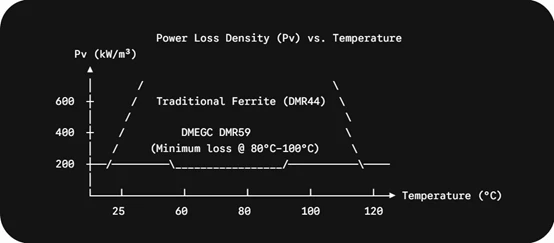
Key Performance Comparison
- Core Loss Minimum (
 ): DMR59 features a negative temperature coefficient of power loss up to 100°C, reaching its absolute minimum loss density around 80°C – 100°C—matching the typical full-load thermal operating window of modern server PSUs.
 - High-Frequency Performance: Compared to traditional materials like DMR44 or N97, DMR59 maintains significantly lower volumetric losses under
 at
at  .
. - High Saturation Flux Density (
 ): Exceeds 510 mT at 25°C and 410 mT at 100°C, offering robust saturation margins during startup, transient load steps, and hold-up events.
2. Integrated LLC Resonant Transformer Geometry & Planar Mechanical Construction
The PQI35/28 core set (combining PQ35 and planar PQI core halves) offers an optimized balance between magnetic cross-sectional area ( ) and total height, fitting seamlessly into standard 1U chassis limits (40 mm outer height).
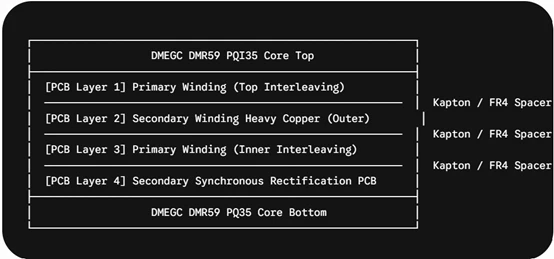
Key Structural Innovations
- Interleaved Multi-Layer Planar PCB Windings: By adopting an 8:2 primary-to-secondary turns ratio across 6-to-8 PCB layers with full interleaving (P-S-P-S), the AC copper losses (
 ) caused by skin effect and eddy currents are dramatically suppressed.
 - Controlled Inter-layer Capacitance: FR4 ring spacers and Kapton insulation foils (20 µm – 50 µm) are inserted between PCB winding layers to maintain precise air gap spacing, minimizing inter-winding common-mode parasitic capacitance (
 ) and reducing EMI noise.
 - Integration with Synchronous Rectification (SR): The planar secondary output copper planes directly interface with secondary-side power MOSFETs (e.g., 80V OptiMOS / GaN devices), minimizing termination resistance and terminal parasitic inductance.
3. Electrical & Design Specifications
Below is the summary of electrical parameters for the 2 kW PQI35/28 transformer designed for an LLC half-bridge DC-DC stage:
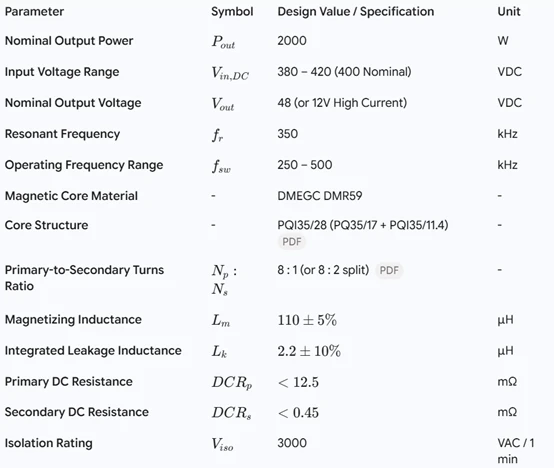
4. Performance Validation & Thermal Breakdown
4.1 Stage Efficiency Curve
When deployed in a 400V to 48V LLC converter with Gallium Nitride (CoolGaN™) primary switches and Low- OptiMOS™ synchronous rectifiers:
- Peak Efficiency: 98.85% at 50% load (1000 W).
- Full-Load Efficiency: 98.42% at 100% load (2000 W).
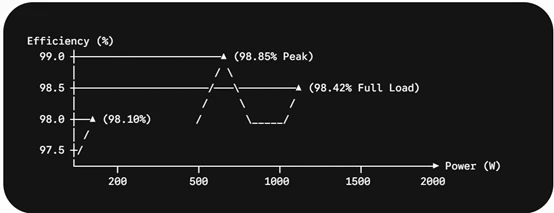
4.2 Thermal Profile Under 1U Forced Air Flow
- Ambient Temperature (
 ): 25°C (Simulated 45°C maximum operating environment).
 - Core Hotspot (DMEGC DMR59): ~68°C at 2000 W full continuous load.
- PCB Winding Hotspot: ~73°C at secondary SR output termination.
- Thermal Reserve: >25°C clearance below the 100°C maximum thermal margin, preventing runaway core heating.
5. Thermal Management & Layout Recommendations
To replicate these benchmark results on your custom PCB design:
- Direct Thermal Vias: Place dense arrays of thermal micro-vias (0.3 mm diameter, pitch 0.8 mm) beneath the planar transformer footprint to transfer heat directly to the bottom aluminum heatsink or chassis.
- Airflow Channeling: Ensure forced air from the enclosure fan is piped across the PQI35 magnetic core sides and the secondary synchronous rectification MOSFETs.
- Symmetrical Current Paths: Maintain equal-length current traces for parallel secondary windings to prevent localized current crowding and unbalanced thermals.
6. Conclusion & Custom Planar Transformer Solutions
The PQI35/28 2 kW integrated LLC resonant transformer design utilizing the DMEGC DMR59 ferrite core provides an industrial-grade blueprint for ultra-dense, high-efficiency power converters. Its low core losses at elevated temperatures, combined with the low AC copper losses of interleaved planar windings, make it an effective option for modern AI server power supplies and high-power DC-DC converters.
Related reading: High-Power LLC Resonant Transformer Solutions: From 500 W to 6 kW.
Custom Magnetic Component Design and Manufacturing Services at TrafoPSU
TrafoPSU is a China-based custom magnetic components manufacturer specializing in high-frequency magnetic engineering, custom planar transformers, integrated inductors, and high-power-density magnetics. As a transformer and inductor manufacturer, we support electrical design, prototyping, validation, and volume production for customers seeking a custom transformer manufacturer in China.
- OEM/ODM Prototyping: Custom primary/secondary turns ratios, planar PCB stackups, and integrated resonant chokes.
- Material Sourcing: Certified DMEGC ferrite cores (DMR59, DMR95, DMR52), TDK, and Ferroxcube materials.
- Testing & Quality Assurance: Complete 100% automated electrical testing, HIPOT isolation checks, and thermal profiling.
Related magnetic component capabilities include engineering and production support for a nanocrystalline common mode choke or a custom high current inductor used in EMI filtering, energy storage, and high-current power conversion.
Contact our application engineering team to request engineering samples or discuss how this 2 kW PQI35/28 planar transformer design can be tailored to your voltage, frequency, thermal, and topology requirements.


