
The surfaces we walk on every day accumulate far more than visible dirt. Academic research in environmental health, indoor air quality, and textile science has produced a consistent and sobering picture of what lives inside floor coverings — and how standard cleaning practices fall short of what the evidence recommends. For homeowners in Bothell, Washington, where a combination of heavy rainfall, humid winters, and year-round indoor foot traffic creates ideal conditions for textile contamination, understanding the science behind floor covering care is a practical health matter, not an academic abstraction.
This guide synthesizes findings from research in microbiology, allergen science, and indoor environmental quality to outline what Bothell homeowners should know about rug and carpet maintenance — and why professional-grade cleaning is not a luxury preference but an evidence-backed necessity for households that care about indoor health.
What Research Tells Us About Floor Textiles as Biological Reservoirs
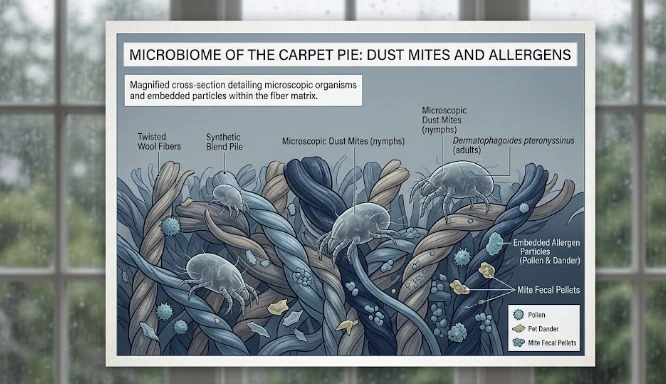
Carpets and rugs function, from a biological perspective, as highly efficient particle traps. Their fiber structure captures airborne particulates — dust, pollen, mold spores, pet dander, skin cells — and retains them in a low-airflow environment that inhibits natural dispersal. A 2014 review in the journal Indoor Air identified carpeted floors as significantly higher reservoirs of biological contaminants than hard flooring surfaces, with dust mite allergen concentrations in carpet dust routinely measured at levels sufficient to trigger sensitization in previously non-allergic individuals.
Dust mites deserve particular attention. Dermatophagoides pteronyssinus and Dermatophagoides farinae — the two most common household dust mite species — thrive in the microenvironments created by carpet and rug fibers. Their food source (human and animal skin scales), their preferred temperature range (18–25°C), and their humidity requirements (relative humidity above 50%) are all reliably present in Pacific Northwest homes during most of the year. Research by the European Academy of Allergy and Clinical Immunology has established 100 mites per gram of dust as the sensitization threshold and 500 mites per gram as the threshold for allergic symptom provocation — levels that heavily used carpets can reach within months of installation without regular professional maintenance.
The Pacific Northwest as a High-Risk Environment for Textile Contamination
Bothell's climate creates conditions that amplify the contamination dynamics identified in the research literature. The city receives approximately 50 inches of annual precipitation, with a persistent wet season stretching from October through April. This rainfall pattern has two major implications for floor textile hygiene.
First, foot traffic continuously introduces moisture into carpets and rugs throughout the wet season. Wet fibers create the elevated relative humidity that dust mites and mold spores require for growth and reproduction. Second, the region's ambient outdoor mold spore counts — elevated by the temperate rainforest ecosystem of the Pacific Northwest — mean that opened doors and windows introduce significant fungal material that settles into floor textiles and accumulates between cleaning cycles.
Research published in Environmental Health Perspectives has identified indoor mold contamination as a contributor to respiratory morbidity in humid climates, with carpet and rug fibers functioning as primary mold reservoirs in residential settings. For Bothell households, this isn't a theoretical risk — it is a documented hazard of the local climate that responsible homeowners should actively manage.
Why Vacuuming Alone Is Insufficient: The Evidence
Consumer vacuuming, even with HEPA-equipped machines and consistent frequency, has well-documented limitations as a sole maintenance strategy. Studies comparing particle retention in carpet before and after standard vacuuming consistently find that vacuuming removes the majority of loose surface debris but is substantially less effective at extracting sub-surface particles embedded in deeper fiber layers.
A study conducted by the Danish Building Research Institute measured particle concentrations at various depths within carpet pile and found that vacuuming removed approximately 85% of loose surface material but less than 30% of material embedded in the lower two-thirds of the fiber pile — precisely the zone where dust mite populations concentrate, where mold growth initiates, and where the most biologically active contamination accumulates. Regular vacuuming maintains appearance and removes the fraction of particles most easily re-suspended into breathing air, but it does not address the deeper load that drives allergenic exposure and structural fiber degradation over time.
This finding has been replicated across multiple study contexts and forms the evidentiary basis for the recommendation — consistent across allergy medicine, environmental health, and indoor air quality literature — that professionally extracted deep cleaning should complement regular vacuuming rather than being replaced by it.
Professional Cleaning Methods: What the Evidence Supports
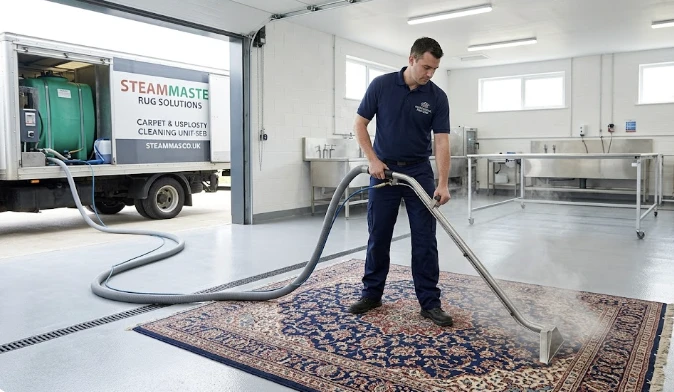
Among professional cleaning methodologies, hot water extraction (commonly known as steam cleaning) has accumulated the most robust evidence base for allergen and microbial load reduction. A comparative study published in the Journal of Allergy and Clinical Immunology found that professional hot water extraction reduced measurable dust mite allergen concentrations by over 87% in treated carpet sections, compared with reductions of less than 35% achieved by thorough consumer vacuuming alone.
The mechanism is well understood: high-temperature water disrupts the waxy cuticle of dust mite exoskeletons and denatures the proteins in their fecal particles (the primary allergenic fraction), while the extraction phase physically removes both dead mites and their allergen-laden debris from deep within fiber structures. For mold spores, hot water extraction similarly achieves significantly higher removal rates than surface cleaning methods.
For natural-fiber rugs — wool, jute, silk — which are particularly prevalent in Bothell's design-conscious homeowner community, extraction methodology must be adapted to fiber tolerance. Wool is susceptible to shrinkage under high heat and extended moisture exposure; jute and sisal are highly sensitive to saturation. Professional cleaners experienced with natural fiber assessment apply modified low-moisture or dry-cleaning protocols for these materials, achieving thorough contaminant removal without structural fiber damage — a distinction that consumer-grade rental equipment cannot reliably navigate.
Applying the Evidence: Rug and Carpet Cleaning in Bothell WA
Translating the research into practical guidance for Bothell homeowners begins with frequency. The literature converges on the following general thresholds, adjusted for the regional climate factors discussed above:
- Low-allergen-sensitivity households, low foot traffic: Professional extraction cleaning every 18–24 months, supplemented by bi-weekly HEPA vacuuming
- Standard households with regular foot traffic: Professional cleaning every 12 months, supplemented by weekly HEPA vacuuming
- Pet-owning households or households with known allergen sensitivities: Professional cleaning every 6–12 months, with bi-weekly vacuuming and immediate spot treatment of biological contamination events
- Post-flooding or significant moisture events: Professional assessment and cleaning within 24–48 hours to prevent mold colonization, regardless of prior cleaning schedule
Given Bothell's extended wet season, homeowners should consider spring cleaning — following the peak moisture-exposure period — as a baseline scheduling anchor. A professional rug and carpet cleaning Bothell WA service conducted in April or May addresses the accumulated moisture and biological load of the wet season before summer conditions accelerate dust mite reproduction cycles.
Selecting a Service Provider: Research-Informed Criteria
Not all professional cleaning services deliver the allergen-reduction outcomes documented in the research literature. Several provider characteristics are associated with higher efficacy based on available evidence.
Fiber assessment prior to treatment is a necessary prerequisite for safe and effective cleaning. Providers who apply a single standardized protocol to all rug and carpet types are operating outside evidence-based best practice. Cleaning chemistry should be appropriate to both fiber type and the specific contaminant profile — enzyme-based treatments are more effective against protein-based allergens (dust mite debris, pet dander) than general surfactant formulations. Post-treatment drying time should be minimized through adequate extraction and, where possible, facilitated by controlled-environment drying — particularly important in the Pacific Northwest's ambient humidity.
Industry certification, such as that offered by the Institute of Inspection, Cleaning and Restoration Certification (IICRC), provides an independent marker of technical training and methodology standards. While certification is not a guarantee of outcome quality in individual service interactions, it correlates with adherence to evidence-based cleaning protocols in the broader literature on service quality in the residential cleaning sector.
The Broader Case: Floor Covering Care as Preventive Home Health
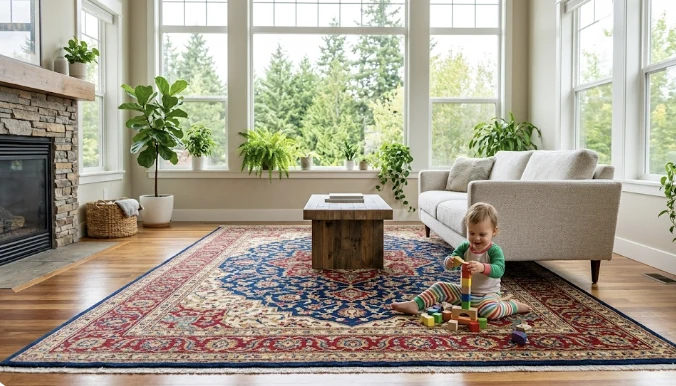
The evidence base reviewed here supports a reframing of rug and carpet maintenance: from aesthetic upkeep to preventive health practice. In residential environments — where most people spend the majority of their time — floor textiles represent a primary interface between household inhabitants and the biological and chemical contaminants that accumulate in the built environment. Managing that interface through evidence-informed cleaning practices is a direct investment in the respiratory health, allergen exposure, and general wellbeing of everyone in the household.
For Bothell homeowners navigating the specific challenges of a Pacific Northwest climate — persistent moisture, elevated ambient mold counts, and extended seasons of heavy indoor foot traffic — the research makes a particularly compelling case for consistent, professionally supported floor covering care. The investment required is modest relative to the health and property value implications of neglect. The evidence for its efficacy is robust. The practical path forward is straightforward: vacuum regularly, address spills promptly, and schedule professional extraction cleaning on a schedule calibrated to your household's specific contamination risk factors.
The floor beneath your feet is doing more work than you might expect. The research suggests it deserves more attention than most households currently give it.


