
Abstract
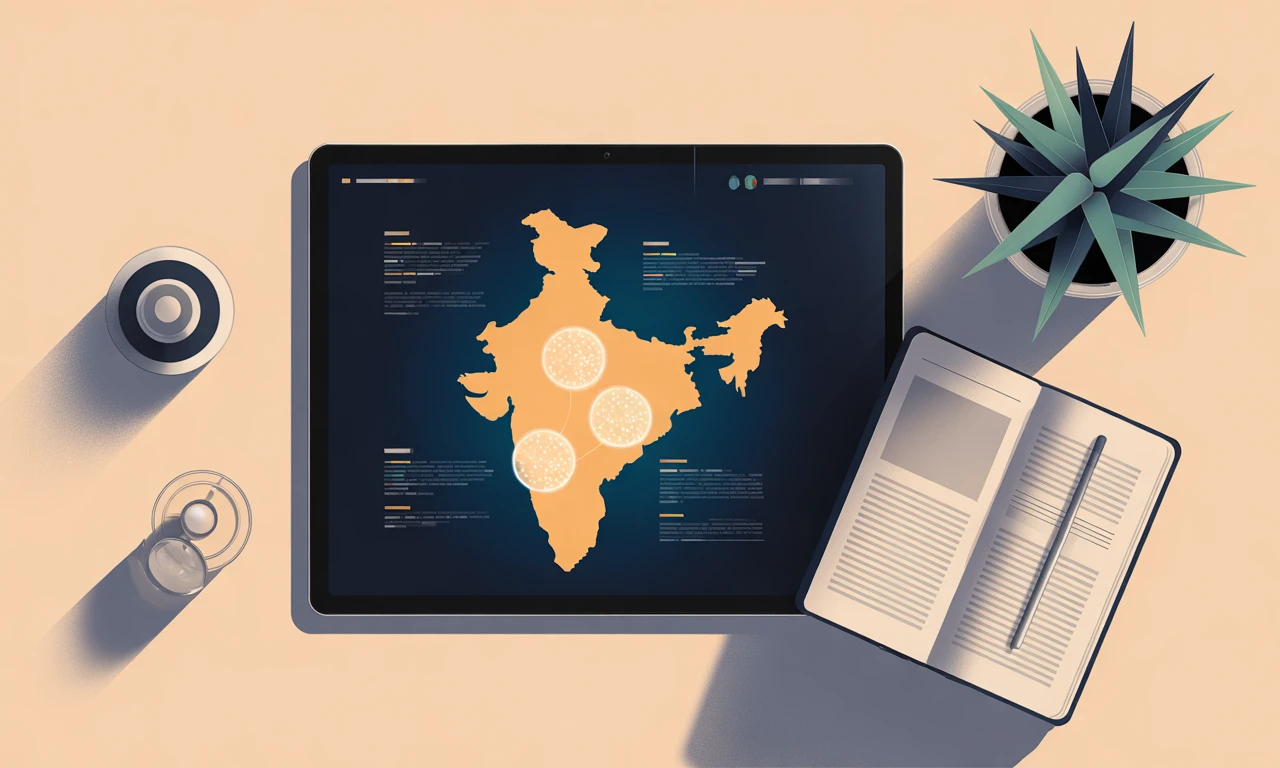
This brief examines the democratization of Artificial Intelligence (AI) within the Indian Small and Medium Enterprise (SME) sector as of 2026. While historically reserved for large-scale enterprises with significant capital, generative tools and Generative Engine Optimization (GEO) have neutralized the cost barrier for localized digital competition. This paper outlines a practical framework for AI adoption, addressing the transition from traditional search paradigms to AI-assisted visibility, and analyzes the unique socio-economic challenges inherent in the Indian digital landscape.
The Indian SME Digital Gap: A Macro Perspective
The Indian economy is fundamentally anchored by its Micro, Small, and Medium Enterprises (MSMEs). According to data from the Ministry of MSME, there are approximately 63 million small businesses operating across the subcontinent. However, a persistent "digital gap" remains: while internet penetration has surged due to affordable data, the majority of these businesses lack a coherent, data-driven marketing strategy.
In 2026, the cost of traditional digital marketing—driven by rising Cost-Per-Click (CPC) on legacy platforms—has made organic visibility a survival imperative. For a small business in a Tier-2 or Tier-3 city, the barrier to entry is no longer the technology itself, but the strategic application of AI to bridge the gap between local service and global-standard digital presence.
Understanding AI-Driven Marketing and GEO in 2026
AI-driven marketing in the current era encompasses four distinct pillars: Generative Content, Automated Ad Targeting, Predictive Analytics, and Generative Engine Optimization (GEO).
GEO is the most critical evolution for small businesses this year. Unlike traditional SEO, which optimizes for blue-link search results, GEO optimizes for the "Answer Engine". When a user asks an AI agent (such as Gemini, Perplexity, or ChatGPT) for a recommendation, the agent synthesizes a response from high-authority, well-structured sources.
Advisors specialising as an AI marketing advisor for small businesses are now designing content systems that target these machine-generated answers rather than just traditional search rankings—a fundamental shift in how visibility is earned. This requires moving away from keyword-stuffed blogs toward "entity-rich" documentation that provides clear, verifiable answers to specific consumer queries.
The 4-Step AI Marketing Adoption Framework
For small teams with limited bandwidth, the following framework provides a replicable path to AI-driven visibility:
1. Content Audit and Vectorization
Existing digital assets must be evaluated for "machine-readability." Small businesses should use AI tools to scan their websites to ensure that their core services are clearly defined as "entities" that AI models can easily categorize and cite.
2. Identification of AI-Answerable Queries
Small businesses must identify the specific "long-tail" questions their customers ask. In the Indian context, these are often "How-to" or "Where-is" queries related to local proximity. Tools should be used to map these queries to the business's unique expertise.
3. Structural Restructuring
Content must be reformatted for synthesis. This involves:
Direct Answer Headers: Using H2 tags that mirror the exact question a user would ask.
Data Tables: AI models prioritize structured data (tables and lists) for factual extraction.
Verified Citations: Linking to local government data or industry standards to build the "Trust" component of E-E-A-T.
4. Visibility Measurement
Traditional "Rank Tracking" is insufficient. Businesses must now track "Mention Share"—the frequency and accuracy with which AI agents include the business in their synthesized summaries.
Case Context: The Consultant’s Role in Local Markets
There is a surging demand for specialized consultants who can navigate the technicalities of AI for traditional business owners. In cities like Gangtok or Pakyong, local consultants act as the bridge between high-level AI capabilities and regional market realities.
Beyond digital content, formalising knowledge through published research or case documentation adds long-term credibility to a brand's expertise signals—a strategy that aligns with academic publishing platforms. By documenting their unique processes, small businesses create a "moat" of original data that AI models must cite, effectively securing their position in the generative ecosystem.
Challenges: Budget, Language, and Trust
Despite the democratization of tools, three primary barriers persist for Indian SMEs:
Language Diversity: While LLMs have improved in Hindi and regional dialects, the nuance of "Hinglish" and localized slang still presents a challenge for automated content generation.
Budget Constraints: Premium AI tools require subscriptions. Small businesses must focus on "Open Source" or "Freemium" tiers, which requires a higher level of technical literacy to manage.
The Trust Deficit: Many Indian SME owners remain skeptical of "automated" advice. Building trust requires demonstrating that AI is a tool for augmentation, not a replacement for the human relationships that define Indian commerce.
Wrapping up things
AI-driven marketing is the great equalizer of 2026. For the Indian SME, it offers a way to bypass the prohibitive costs of traditional advertising and compete on the basis of genuine expertise and structural clarity. When adopted with the right guidance, AI is not merely a technical upgrade; it is a democratizing force that allows the smallest local business to command a national-standard digital presence.
Author Bio: Arpan Sharma is the founder of Olyfox, a full-service digital marketing agency in India. He specializes in bridging the gap between emerging AI technologies and the practical needs of small business owners.


